Is AI Writing Plagiarism? What You Need to Know
Whether AI writing counts as plagiarism is more nuanced than a yes-or-no answer — it depends on how the AI-generated content is used and what standard (legal, academic, or ethical) you’re measuring it against. Here’s a clear breakdown.
The legal/copyright answer
AI-generated text is not plagiarism in the traditional legal sense of copying a specific, identifiable copyrighted work, because large language models generate new text based on statistical patterns learned across huge amounts of training data rather than retrieving and copying a specific source verbatim (in most cases — verbatim reproduction of training data does occasionally happen, and is a separate, actively litigated copyright question). So “did the AI copy from one specific source” is usually not the right question — the more relevant one is usually about disclosure and originality.
The academic integrity answer
Most schools and universities now explicitly classify submitting AI-generated writing as your own original work, without disclosure, as a violation of academic integrity policy — functionally treated the same as having someone else write your paper, even though no specific human or document was “copied from.” This is a policy-based definition, not a copyright-based one, and it’s the definition that actually gets students penalized, so checking your specific institution’s current AI policy matters more than the general copyright question.
The professional/publishing answer
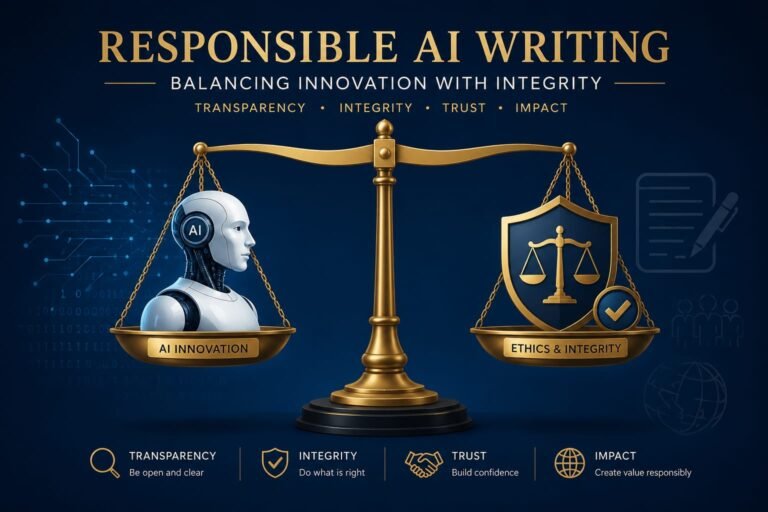
In professional and publishing contexts, most style guides and industry bodies are converging on a disclosure-based standard: using AI as a drafting or editing tool is broadly accepted, but presenting substantially AI-generated work as entirely your own original writing without any disclosure, particularly in contexts like journalism or academic publishing, is increasingly treated as an ethical violation even without a traditional plagiarism claim attached.
AI detection tools and their real accuracy
AI content detectors (Turnitin’s AI detection, GPTZero, and similar tools) are widely used but have documented accuracy problems — both false positives (flagging genuinely human-written text as AI-generated, disproportionately affecting non-native English speakers whose writing patterns can trigger these tools) and false negatives (missing AI-generated text that’s been lightly edited). Relying entirely on a detection tool’s verdict, in either direction, is not a reliable standard on its own.
What actually reduces risk
Disclosure, where required or expected, is the single most protective practice — telling a professor, editor, or client that AI assisted with a draft, when policy requires or expects it, removes the ethical ambiguity entirely regardless of how the underlying text was generated. Substantial editing and addition of your own genuine analysis, voice, and verified facts also meaningfully changes the nature of the final work from “AI output” to “AI-assisted work,” which most policies treat more favorably than unedited AI output presented as fully original.
Plagiarism, Copyright, and AI: Three Different Questions
Plagiarism is about presenting someone else’s work as your own, copyright is about legal ownership and permission, and detection is about software guessing whether text looks machine-written. They are separate issues. Text produced by AI is not automatically copied from a specific source, but it can sometimes closely resemble existing material, so checking with a plagiarism scanner is still sensible for published work. The U.S. Copyright Office AI resources explains how copyright applies to AI-generated material.
Academic and Workplace Rules
Schools and employers set their own policies. Some ban AI assistance, others allow it with disclosure. Read the policy that applies to you and disclose your use where required.
Frequently Asked Questions
Can AI detectors prove AI use? No. They give probabilities and can be wrong.
Do I own AI-written text? Ownership rules for AI output are still developing and depend on how much human authorship is involved.
How do I stay safe? Add your own analysis, cite sources, and follow the rules of your institution.
The practical bottom line
“Is AI writing plagiarism” doesn’t have one universal answer — it depends on whether you’re asking about copyright law, academic policy, or professional ethics, and each has converged on a different but related standard. Checking the specific policy that actually applies to your situation, and defaulting to disclosure when in doubt, is the safest practical approach across all three.