
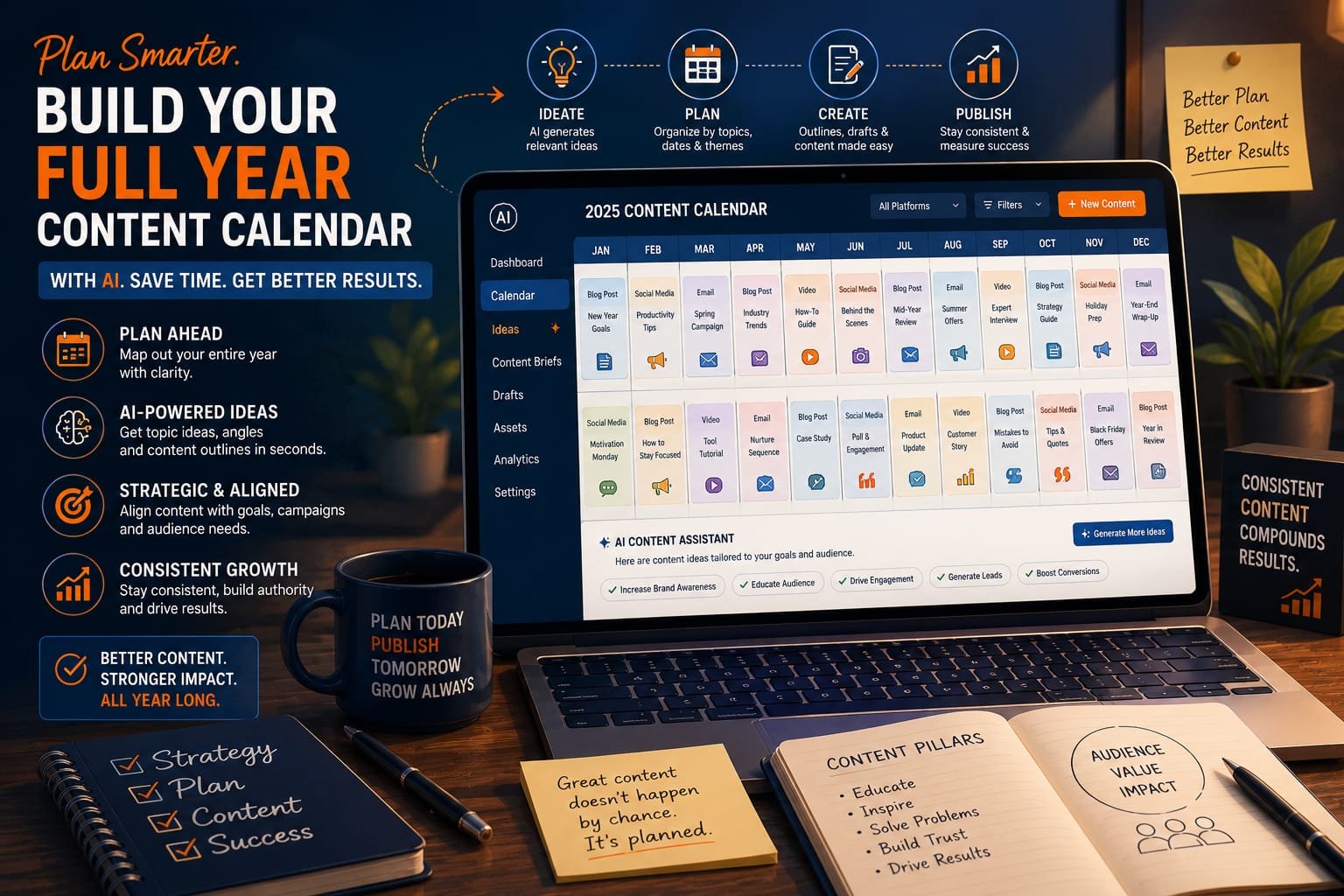
AI Content Strategy: How to Plan a Full Year of Content in One Afternoon
Content strategy for most businesses exists in one of three states: nonexistent (posting randomly when someone has time), reactive (responding to current events and opportunities without a plan), or planned but not executed (a beautiful strategy document that sits unused after the kickoff meeting). AI has made a fourth state newly possible: a comprehensive, execution-ready full-year content plan built in a focused afternoon. This guide provides the exact process.
Why Content Strategies Fail — And How AI Addresses It
Most content strategies fail not from lack of intent but from the gap between planning and execution. The planning process is time-consuming, requiring audience analysis, keyword research, competitive analysis, content calendar creation, and distribution planning — work that realistically takes weeks of scattered attention or days of focused work. By the time the plan is complete, enthusiasm has waned and market conditions have shifted. AI compresses this gap by handling the mechanical and organizational work of content planning in minutes rather than days, allowing human energy to focus on the strategic judgments and creative direction that actually require human expertise. For turning your content strategy into actual content, see our guide on Best AI Prompts for Business Writing.
The One-Afternoon Content Strategy System — Overview
The system uses four work sessions: audience and goal definition (30 minutes), topic and keyword research (45 minutes), content calendar and pillar planning (60 minutes), and distribution and measurement framework (30 minutes). Total time: approximately 2.5 to 3 hours of focused work producing a year’s worth of content direction.
Session 1 — Audience and Goal Definition (30 Minutes)
Open Claude and begin with: “I am developing a content strategy for [describe business/practice/organization]. Our primary audience is [describe audience in detail — role, industry, challenges, information needs, where they consume content]. Our content goals for the next 12 months are [list 2-3 specific goals — leads generated, brand awareness in specific market, client education, thought leadership in specific area]. What questions does our audience most need answered? What content would build our credibility with them specifically? What misconceptions does our audience commonly hold that we are positioned to address?”
Review and refine Claude’s output with your actual knowledge of your audience. Approve the audience and goal framework before proceeding — this foundation drives everything else.
Session 2 — Topic and Keyword Research (45 Minutes)
Build your topic universe: “Based on this audience and these goals [paste from Session 1], generate 50 specific content topic ideas. For each topic, provide: the specific question or problem it addresses, whether it is educational, promotional, or thought leadership content, and the approximate search intent (informational, commercial, navigational). Organize by topic cluster so related topics appear together.”
For keyword validation, use a free tool like Google Keyword Planner or Ubersuggest to confirm search volume for your top 20 prioritized topics. AI generates topic ideas efficiently; keyword volume data requires a dedicated tool. For how this topic research translates into actual content creation, see our guide on AI for Email Writing for similar prompt-based efficiency.
Session 3 — Content Calendar and Pillar Structure (60 Minutes)
Create your pillar structure: “From these 50 topics [paste list], organize them into 4-6 content pillars — broad thematic areas that together address our audience’s complete information needs. For each pillar, identify: 2 comprehensive long-form pillar articles (1500+ words), 4-6 supporting cluster articles (800-1000 words), and 10-15 social media topics. This is our topic cluster architecture.”
Then build the calendar: “Create a 52-week content publishing calendar using this pillar architecture. Publish one pillar article and one cluster article per week, with social content distributed Monday-Wednesday-Friday. Include seasonal and topical content hooks where relevant for [your industry]. Format as a table with Week, Content Title, Pillar, Format, and Key Message columns.”
Session 4 — Distribution and Measurement Framework (30 Minutes)
“Create a content distribution playbook for each piece we produce. For a long-form article: what social platforms get what adaptation, with what timing after publish. For thought leadership content: what professional networks and communities reach our audience. For educational content: what email segment receives it and when. Also define 3 primary KPIs for our content program with specific monthly targets, and define what would cause us to adjust the strategy mid-year.”
Making the Strategy Execution-Ready
A strategy that lives in a document is not a strategy — it is a plan. Turn your AI-developed strategy into an execution system: import the content calendar into your team’s project management tool, assign each piece an owner and due date, create brief for each article using AI, and schedule the first month’s content before any other work. The first month of execution matters more than the perfection of the remaining 11 months of planning.
Frequently Asked Questions About AI Content Strategy
Is AI-generated content strategy as good as a professional content strategist? For many small and medium businesses, the AI-assisted process in this guide produces a strategy of comparable quality to professional consultation at a fraction of the cost. For complex organizations with multiple audiences and channels, professional strategic guidance still adds value.
How often should I revisit and update the strategy? Quarterly review of performance data and monthly adjustment of upcoming content topics keeps the strategy responsive without requiring constant re-planning.
What if AI generates topics that do not feel right for our brand? Override them. AI generates options — you make the final judgment about what fits your voice, values, and audience. The AI serves the strategy; the strategy does not serve the AI output.
Conclusion
A full year of content strategy built in one afternoon is not a shortcut — it is an efficiency achievement that allows human strategic judgment to be applied to genuine decisions rather than mechanical planning work. Use AI to handle the framework, research, and organization that previously consumed days of scattered effort. Invest your human energy in the audience insight, brand judgment, and creative direction that AI cannot provide. Execute the first month before any other meetings or planning activities. The strategy that exists is always more valuable than the perfect strategy still being developed. For turning strategy into content, read our guides on Best AI Prompts for Business Writing and How to Use AI for Research.